The fervent online search for “bible blueprints PDF free” reveals a deep fascination with recreating sacred spaces, driven by faith and historical curiosity.
Many seek detailed plans, hoping to visualize and even physically reconstruct structures described in scripture, connecting with ancient traditions.
The Search for “Bible Blueprints PDF Free” ⎼ Understanding the Demand
The intense online pursuit of “Bible blueprints PDF free” stems from a confluence of motivations. Individuals and groups desire a tangible connection to biblical narratives, seeking to visualize the Tabernacle, Solomon’s Temple, and Ezekiel’s visionary Temple.
This demand is fueled by both religious devotion and academic interest. Many wish to construct scale models for educational purposes, Sunday school projects, or personal study. The availability of free PDF plans lowers the barrier to entry, making these ambitious projects accessible to a wider audience.
However, the search also highlights a desire to understand the architectural and symbolic significance of these sacred structures, exploring their potential influence on later architectural styles.
Historical Context: Why Reconstruct Biblical Structures?
Throughout history, reconstructing biblical structures has represented a profound desire to connect with the divine and understand ancient worship practices. Early architectural studies and drawings, though often speculative, aimed to visualize these sacred spaces.
The impulse extends beyond mere historical curiosity; it’s rooted in theological significance. Recreating the Tabernacle or Temple allows for a deeper engagement with scripture, fostering a sense of spiritual connection.
Modern reconstruction projects, including detailed models built by dedicated groups, demonstrate a continued fascination with these architectural marvels and their symbolic weight, fueled by readily available, though sometimes inaccurate, plans.

The Tabernacle: The First Divine Blueprint
The Tabernacle stands as the initial, divinely ordained architectural plan, meticulously detailed in Exodus, serving as a portable sanctuary and a precursor to the Temple;
Detailed Examination of Tabernacle Plans
Examining Tabernacle plans reveals a rectangular structure, covered by layers of materials symbolizing protection and holiness. PDF resources often depict the outer court, the Holy Place, and the Most Holy Place, highlighting their precise dimensions.
These plans showcase the Ark of the Covenant’s central placement within the Most Holy Place, emphasizing its significance. Detailed drawings illustrate the altar for burnt offerings, the laver for priestly washing, and the golden lampstand. Many free PDF versions attempt to reconstruct the intricate curtain system, separating the different sections.
Understanding these plans requires careful attention to cubit measurements and the symbolic meaning behind each element, offering a glimpse into ancient Israelite worship.
Materials and Dimensions: A Precise Divine Specification
Biblical accounts detail remarkably specific materials and dimensions for the Tabernacle, often found within “bible blueprints PDF free” resources. Gold, silver, bronze, acacia wood, linen, and animal skins were divinely ordained, each holding symbolic weight.
The plans emphasize precise measurements in cubits – a unit based on forearm length – demonstrating God’s meticulous nature. PDF downloads frequently include charts converting cubits to modern measurements. The Tabernacle’s dimensions (45 x 15 x 15 feet) were carefully prescribed, influencing its proportions.
These specifications weren’t arbitrary; they reflected a divine order and purpose, meticulously detailed for faithful replication.
Symbolism Embedded in the Tabernacle’s Design
“Bible blueprints PDF free” often highlight the rich symbolism woven into the Tabernacle’s structure. Every element—from the Ark of the Covenant to the altar—represented a facet of God’s character and His relationship with Israel.
The Holy of Holies symbolized God’s presence, accessible only to the High Priest. The veil separating the Holy Place from the Most Holy Place represented separation from sin. The bronze altar signified sacrifice and atonement.
Detailed plans reveal how the Tabernacle’s layout mirrored the cosmos, reflecting a divine order. These symbolic layers deepen understanding beyond mere architectural form.

The Temple of Solomon: Expanding on the Divine Model
“Bible blueprints PDF free” searches reveal interest in Solomon’s Temple, a grand expansion upon the Tabernacle’s design, showcasing architectural innovations and increased scale.
Architectural Innovations in Solomon’s Temple
The demand for “bible blueprints PDF free” often centers on Solomon’s Temple, a structure vastly different from the portable Tabernacle. Its permanent foundation and massive stone construction represented a significant leap in architectural complexity.
Innovations included a three-part structure – the porch, the Holy Place, and the Holy of Holies – each with specific purposes and ornamentation. Elaborate bronze pillars, a massive bronze sea, and intricate carvings adorned the Temple, showcasing unparalleled craftsmanship.
The Temple’s design incorporated advanced engineering techniques for its time, demonstrating a sophisticated understanding of structural integrity and aesthetics. Detailed plans, if available, would reveal the precise methods used to achieve such grandeur, fueling the ongoing search for accessible resources.
Comparing Tabernacle and Temple Blueprints
The pursuit of “bible blueprints PDF free” highlights a common desire: to compare the designs of the Tabernacle and Solomon’s Temple. The Tabernacle, a portable sanctuary, emphasized flexibility and ease of movement, reflected in its tent-like structure and modular components.
In contrast, the Temple was a permanent, monumental edifice, showcasing fixed dimensions and elaborate ornamentation. While both structures shared symbolic elements – representing God’s presence – their architectural approaches differed significantly.
Comparing detailed plans would reveal how Solomon’s builders expanded upon the Tabernacle’s design, incorporating new features and materials. Understanding these differences provides insight into the evolving relationship between God and Israel.
The Role of Hiram of Tyre in Temple Construction
The search for “bible blueprints PDF free” often leads to inquiries about the artisans involved in building Solomon’s Temple, particularly Hiram of Tyre. Hiram, a master craftsman, was renowned for his skill in bronze work and supplied essential materials and expertise for the Temple’s construction.
His contributions extended beyond materials; Hiram designed intricate bronze features, including the Sea and pillars Jachin and Boaz, detailed in potential blueprint reconstructions. The biblical account emphasizes a collaborative relationship between Solomon and Hiram, highlighting the importance of skilled labor.
Analyzing Temple plans reveals the sophistication of Hiram’s designs, showcasing a blend of Israelite religious symbolism and Phoenician artistic traditions.

Ezekiel’s Vision of the Future Temple
The quest for “bible blueprints PDF free” extends to Ezekiel’s complex vision, demanding careful interpretation of Ezekiel 40-48’s detailed, yet challenging, architectural descriptions.
The Complexity of Ezekiel 40-48

The intense online interest in “bible blueprints PDF free” frequently centers on Ezekiel’s Temple, yet these chapters present formidable interpretive hurdles. Scholars widely acknowledge Ezekiel 40-48 as among the most difficult passages in the entire Bible, brimming with precise measurements and intricate details.
Reconciling these specifications into coherent architectural plans proves exceptionally challenging, often leading to diverse and sometimes conflicting reconstructions. The text’s symbolic nature further complicates matters, blurring the lines between literal description and prophetic imagery.
Consequently, finding a definitive “blueprint” is elusive, and available PDFs often represent one interpretation among many, requiring critical evaluation.
Villalpando’s Interpretations and Illustrations
The demand for “bible blueprints PDF free” often leads to encountering the work of Juan Bautista Villalpando, a 17th-century Spanish priest whose detailed illustrations profoundly influenced interpretations of Ezekiel’s Temple. Villalpando dedicated years to meticulously reconstructing the Temple based on his understanding of the biblical text.
His elaborate engravings, widely circulated, became the standard visual representation for generations, shaping expectations of what the Temple might have looked like. However, it’s crucial to recognize that Villalpando’s work represents a specific interpretation,
not a definitive blueprint, and his influence has waned over time, with modern scholarship offering alternative perspectives.
Challenges in Reconciling Ezekiel’s Vision with Physical Reality
The pursuit of “bible blueprints PDF free” frequently encounters the immense difficulty of translating Ezekiel’s highly symbolic and detailed vision into a physically constructible building. Ezekiel 40-48 presents numerous architectural anomalies and measurements that defy conventional building practices.
Scholars debate whether Ezekiel intended a literal, buildable structure or a symbolic representation of spiritual realities. The sheer scale and complexity of the Temple, coupled with ambiguous descriptions, pose significant challenges.
Reconciling the text with archaeological evidence and architectural feasibility remains a major hurdle, leading to diverse and often conflicting reconstruction proposals.
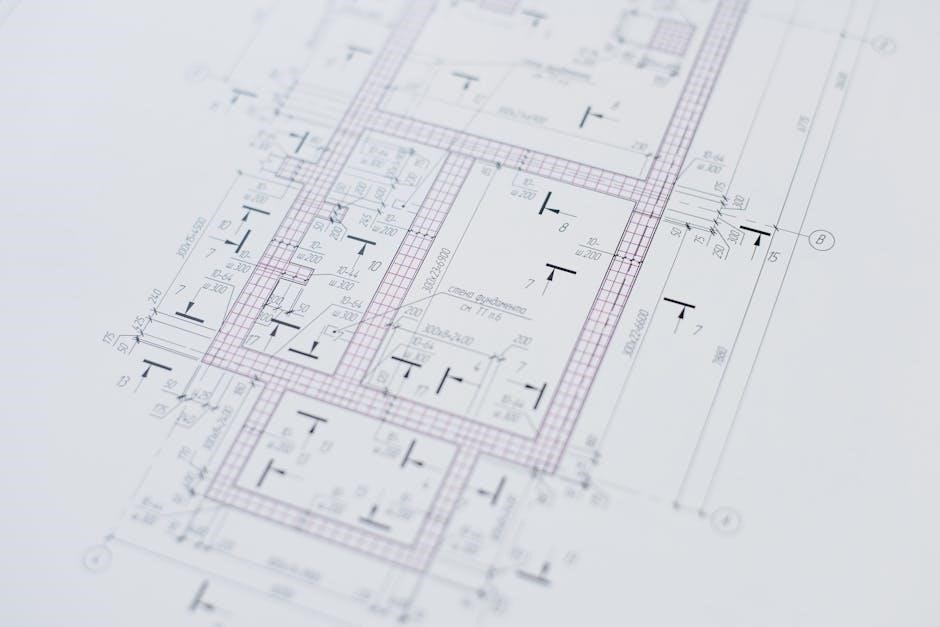
Historical Attempts at Tabernacle & Temple Reconstruction
Early studies and drawings, alongside modern projects and Sunday School manuals, demonstrate a long-held desire to visualize biblical structures, fueled by the search for “bible blueprints.”
Early Architectural Studies & Drawings
Before the digital age and the widespread availability of “bible blueprints PDF free” downloads, scholars and enthusiasts relied on meticulous textual analysis and artistic interpretation. Early architectural studies, dating back centuries, attempted to reconstruct the Tabernacle and Temple based solely on biblical descriptions.
These efforts often resulted in detailed drawings and renderings, showcasing various interpretations of the structures’ dimensions, materials, and ornamentation. While lacking the precision of modern CAD designs, these historical depictions represent significant milestones in the quest to visualize sacred spaces. They laid the groundwork for later reconstruction attempts and continue to inspire those seeking a tangible connection to biblical history.
Modern Reconstruction Projects & Models
The internet’s proliferation of “bible blueprints PDF free” has fueled a surge in modern reconstruction projects, ranging from small-scale models to ambitious full-size replicas. These endeavors utilize contemporary architectural techniques and materials, informed by both biblical texts and historical research.
Dedicated groups and individuals meticulously construct Tabernacle and Temple models, often as educational tools or expressions of faith. Some projects involve detailed craftsmanship, replicating intricate details based on available plans. These reconstructions offer a unique opportunity to engage with biblical architecture in a tangible way, fostering a deeper understanding of its symbolism and significance.
Sunday School Projects and Detailed Manuals
The accessibility of “bible blueprints PDF free” has significantly impacted religious education, particularly within Sunday School programs. Many churches utilize these plans for hands-on learning experiences, engaging children and adults in constructing miniature Tabernacle or Temple models.
Detailed manuals, like the one requiring two years of Bible classes and 100 hours of work, provide comprehensive instructions and historical context. These resources aim to furnish complete sets of plans for building accurate representations, fostering a deeper appreciation for biblical architecture and its spiritual meaning within a community setting.
The Bible as a “Blueprint” for Salvation ─ A Metaphorical Connection
Just as architectural blueprints guide construction, the Bible offers a divine plan for spiritual life, providing principles for building a righteous and fulfilling existence.
Understanding the Blueprint Analogy
The comparison of the Bible to a blueprint isn’t literal, but powerfully illustrates its role as a detailed guide for life’s construction. Like a pharmacist relying on blueprints for a new store, individuals can utilize biblical principles for building character and purpose.
This analogy suggests a deliberate, divine design for humanity, offering a framework for moral and spiritual development. Each “instruction” within scripture, like dimensions on a plan, contributes to a harmonious and stable “structure” of faith.
Understanding this blueprint requires careful study and application, mirroring the effort needed to interpret and execute architectural plans effectively.
Applying Biblical Principles to Life’s “Construction”
Just as a building requires a strong foundation, life benefits from core biblical truths like love, forgiveness, and integrity. These principles serve as the load-bearing walls of our character, providing stability amidst challenges.
Each decision becomes a “building block,” carefully placed according to the divine plan. Constructive choices – kindness, honesty, service – contribute to a flourishing life, while detrimental ones create weaknesses.
Regular “inspections” – self-reflection and prayer – help identify areas needing repair or reinforcement, ensuring a resilient and purposeful existence built on a solid foundation.

Resources for Finding Biblical Architecture Plans Online
Numerous websites offer biblical architecture plans, but caution is vital. Verify source legitimacy to avoid copyright issues and inaccurate, potentially misleading “free PDF” downloads.
Legitimate Sources for PDF Downloads
Finding reliable PDF downloads of biblical architecture plans requires careful navigation. While a truly “free” comprehensive set is rare, several avenues offer valuable resources. Seminary and theological college websites often host scholarly articles and accompanying diagrams, sometimes available for download.
Additionally, reputable historical and archaeological societies may provide access to researched reconstructions and associated plans, often for a fee or membership access. Beware of sites promising complete, high-resolution blueprints for free; these frequently contain inaccuracies or copyright violations.
Consider exploring academic databases and digital libraries, utilizing keywords like “Tabernacle plans,” “Solomon’s Temple reconstruction,” or “Ezekiel’s Temple diagrams.” Always prioritize sources with clear attribution and scholarly backing to ensure accuracy and respect intellectual property.
Avoiding Copyright Infringement and Scams
The pursuit of “bible blueprints PDF free” carries risks of copyright infringement and encountering online scams. Many freely available plans lack proper licensing or attribution, potentially violating intellectual property rights. Be cautious of websites requesting personal information or financial details in exchange for downloads – these are often phishing attempts.
Prioritize sources that clearly state their licensing terms and offer attribution to the original creators. Avoid downloading from untrustworthy file-sharing sites or those riddled with intrusive advertisements.
Remember that professionally researched and accurately rendered plans often require payment to compensate the authors and researchers involved. Supporting legitimate sources ensures continued access to reliable information and ethical practices.
Evaluating the Accuracy of Online Plans
When seeking “bible blueprints PDF free,” critical evaluation is paramount. Numerous plans circulate online, varying drastically in accuracy and scholarly rigor. Many interpretations exist, particularly concerning Ezekiel’s Temple, leading to conflicting designs.
Assess the source’s credibility – is it affiliated with a recognized archaeological institution or theological scholar? Cross-reference dimensions and details with multiple biblical texts and commentaries.
Be wary of plans lacking detailed explanations of interpretive choices or relying on unsubstantiated assumptions. Look for plans that acknowledge the inherent challenges and ambiguities in reconstructing ancient structures.

The Influence of Biblical Architecture on Later Styles
Biblical architectural forms profoundly impacted subsequent designs, notably influencing early Christian basilicas and echoing patterns found in Ancient Near Eastern structures.
Connections to Ancient Near Eastern Architecture
The architectural designs detailed within biblical texts weren’t born in isolation; they demonstrably drew heavily from established traditions of the Ancient Near East. Structures like the Tabernacle and Solomon’s Temple exhibit clear resonances with contemporary Mesopotamian and Egyptian temple layouts and decorative motifs.
Features such as monumental gateways, courtyard arrangements, and the use of specific building materials—like cedar wood—were commonplace in the region. The emphasis on axial symmetry and hierarchical spatial organization also reflects prevailing architectural principles. Understanding these connections provides crucial context for interpreting biblical descriptions and appreciating the cultural milieu in which these sacred spaces emerged.
Impact on Early Christian Basilica Design
The conceptual and spatial arrangements found in biblical architecture, particularly the Temple of Solomon, profoundly influenced the development of early Christian basilica design. The longitudinal layout, with a central nave and side aisles, echoes the division of sacred space in the Temple courts.
The emphasis on a focal point—the altar—mirrors the Holy of Holies. Furthermore, the use of columns and a raised apse likely stemmed from Solomonic Temple precedents. Early Christians, seeking to establish continuity with Jewish religious traditions, consciously adopted and adapted these architectural elements, imbuing them with new theological significance.
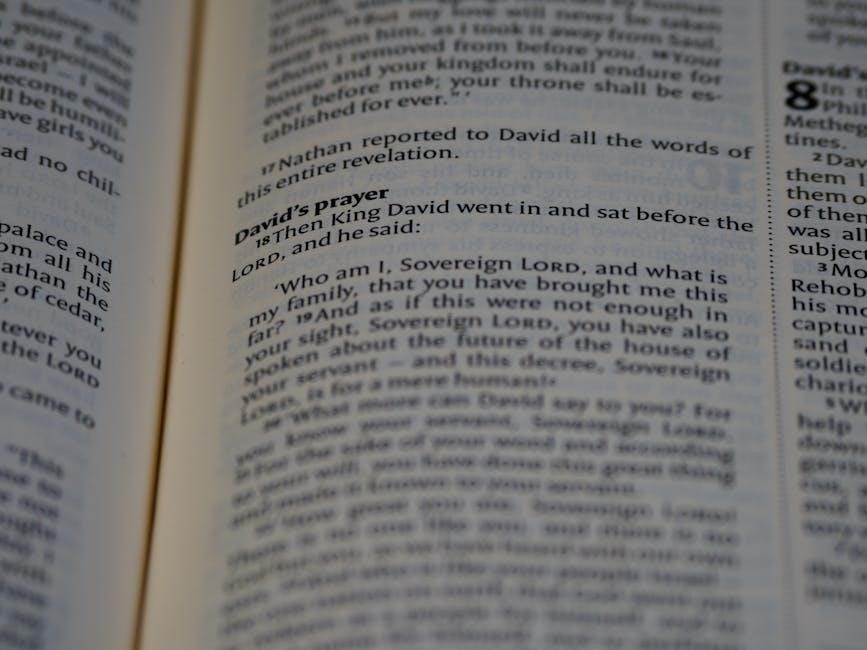
Theological Implications of Sacred Space
Biblical architecture articulates faith materially, demonstrating God’s intentionality in how humanity relates to the divine through built environments and liturgical practices.
Architecture as an Expression of Faith
The very act of designing and constructing the Tabernacle and Temple wasn’t merely a practical undertaking; it was a profound expression of Israel’s faith and obedience to God’s commands. These structures weren’t simply buildings, but tangible representations of their covenant relationship with the divine.
Each dimension, material, and decorative element held symbolic weight, reflecting theological truths and God’s character. The meticulous detail in the biblical descriptions underscores the importance of reverence and intentionality in worship. Seeking “bible blueprints PDF free” reflects a desire to understand and connect with this sacred artistry, recognizing architecture as a powerful medium for communicating faith.
The Relationship Between God and Built Environments
The biblical narrative demonstrates God’s deliberate engagement with built environments, from instructing Noah on the Ark’s design to commanding the construction of the Tabernacle and Temple. These weren’t afterthoughts, but integral components of His plan for relating to humanity.
The desire to find “bible blueprints PDF free” stems from recognizing that sacred space isn’t neutral; it shapes worship, fosters community, and embodies theological beliefs. God’s presence was uniquely manifested in these structures, signifying His commitment to dwelling with His people. Exploring these architectural plans offers insight into this divine-human interaction.
Jean-François Félibien des Avaux and the Hybrid Chronology
Félibien’s work attempted to reconcile biblical timelines with pagan histories, influencing architectural thought and sparking debate about the origins of sacred design.
Reconciling Scriptural and Pagan History in Architecture
Jean-François Félibien des Avaux’s ambitious project centered on harmonizing seemingly disparate historical narratives – those presented in the Bible and those documented in classical, pagan sources. He questioned whether these accounts could be fitted together, or if they represented fundamentally irreconcilable worldviews.
This pursuit wasn’t merely academic; it had profound implications for understanding the development of architecture. Félibien believed that architectural styles weren’t born in a vacuum, but rather evolved through a complex interplay of influences, potentially including a shared, ancient origin rooted in biblical events. His Recueil Historique explored this idea, attempting to trace a continuous lineage from scriptural accounts to later architectural achievements.
The Recueil Historique de la Vie et des Ouvrages des plus célèbres Architectes (1687)
Félibien’s Recueil Historique, published in 1687, was a monumental work aiming to establish a comprehensive history of architecture, interwoven with biographical sketches of prominent architects. Crucially, it wasn’t a purely stylistic survey; it was a vehicle for his hybrid chronology, attempting to reconcile biblical timelines with those derived from pagan sources.
The book presented a narrative where architectural innovation wasn’t solely a product of Greco-Roman genius, but potentially built upon foundations laid down in biblical times. Félibien sought to demonstrate continuities, suggesting that even seemingly pagan architectural elements might have roots in earlier, divinely inspired designs, influencing the search for “bible blueprints.”